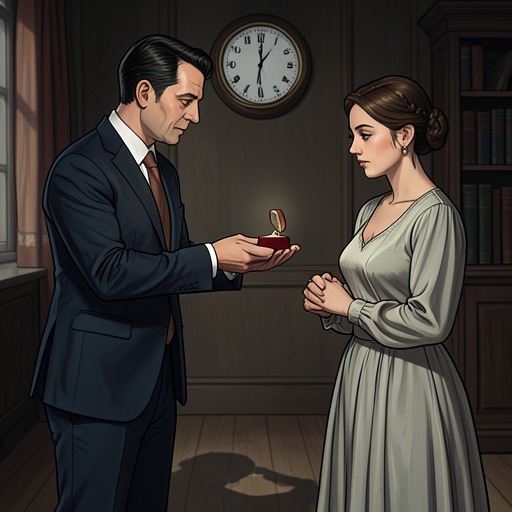
Hardin repeatedly asks Tessa to marry him
After Ever HappyHardin repeatedly asks Tessa to marry him while she is still questioning whether their relationship can be trusted. Across several encounters, the proposal shifts from a confident assertion that they will never remain apart to an impulsive plea shaped by remorse and fear of losing her. Tessa’s refusals make clear that wanting marriage is not the same as being ready to accept it: she needs the offer to express a considered commitment, not to override the hurt between them.
Proposals Amid Separation
The first exchange begins with Tessa drawing a boundary: she wants Hardin in her life, but not as her boyfriend. His humorous, hopeful response, “Husband?”, turns her attempt to define a lesser form of closeness into a sudden proposal. Tessa is astonished that he would invoke marriage when they are not together. She objects that he cannot use it to change her mind; she had wanted him to want marriage, rather than offer it as a last resort.
Hardin insists that the offer is not a tactic. He says he has learned from their history of games and wants to marry her because he cannot imagine living otherwise. His certainty extends beyond the proposal itself: he argues that they may as well marry because they will not stay apart. Tessa hears both assurance and presumption in this claim. His confidence about their eventual reunion does not answer her objection that marriage must be wanted for its own sake, rather than deployed to settle a conflict or reverse a separation.
Her hesitation also reflects a broader skepticism about marriage as a guarantee. Tessa has learned that her parents only pretended to be married to appease her mother and grandparents, while Trish and Ken’s real marriage did not prevent their relationship from failing. To her, legal binding does not ensure happiness; the expectation that partners should promise themselves to one another and depend on that person for happiness has begun to seem misguided. The proposal therefore meets not just personal doubt about Hardin, but doubt about what marriage can promise at all.
Refusal and Repetition
In a later, intimate exchange, Hardin asks, “Will you marry me?” while moving with soft laughter beneath Tessa. She answers, “No,” and swats at him, hoping he is only teasing. He immediately offers a different form of closeness, asking whether she will move in with him; she refuses that as well. The paired offers make the difference between what Hardin wants and what Tessa can accept especially visible: neither a marriage proposal nor shared living arrangements can bypass the questions she is not ready to answer.
The playful physical setting does not turn her refusal into consent or agreement. Tessa traces the tattoos on Hardin’s chest, including the heart-shaped end of an infinity symbol, while declining his offers. The scene holds affection and resistance together: intimacy remains possible, but it does not amount to a settled relationship or a promise of marriage. Her no is repeated plainly, even as their closeness gives Hardin room to ask again.
Remorse and a Final Plea
In a later exchange narrated by Hardin, he reflects that Tessa believes he did not want her. He says he has loved her deeply, acknowledges that he kept trying to ruin the only good thing in his life, and accepts responsibility for making her feel this way. He also connects his belated effort to change with her father’s death, admitting that it took that loss for him to get his life in shape. His apology does not erase the harm; it names his own conduct as its cause.
Hardin then says he loves Tessa more than ever and does not care if they cannot have babies, before adding, “Marry me.” The sequence gives the proposal a weight different from the earlier teasing exchange: it now follows an admission of fault and an assurance that their possible inability to have children would not alter his wish to be with her. Yet he makes the request impulsively, because he is desperate and dislikes the look in her eyes. Tessa glares at him and tells him to stop throwing marriage into the conversation. When he starts to offer to buy a ring first, she warns him again, resisting the idea that a ring could make the request more considered.
Hardin rolls his eyes, promises that he is in love with her, and reaches for her. Tessa backs away and challenges the timing of his declaration, saying, “Yeah, now you are.” He answers that he has been in love with her for a long time. The exchange leaves the proposal unresolved: his stated history of love confronts her experience of his recent change, and neither a promise nor an explanation produces an acceptance in the scene.
Significance and Outcome
The repeated requests show Hardin trying to turn an uncertain, repeatedly damaged bond into an explicit promise. Their recurrence is not evidence that Tessa has agreed; each time, she distinguishes his desire for a shared future from her readiness to enter one. His words grow more accountable, moving from certainty that they will never be apart to an apology that names his destructive behavior and accepts a possible future without children, but the pattern of proposing before Tessa is persuaded remains.
The action consequently leaves commitment as a question rather than a completed outcome. Hardin can declare what he wants and acknowledge what he has done, but Tessa’s responses insist that a marriage proposal cannot substitute for trust or dictate the timing of reconciliation. The gap between his certainty and her guardedness is the central tension of the repeated proposals.